
Join the ICONS
Dance ICONS is a global network for choreographers of all levels of experience, nationalities, and genres. We offer a cloud-based platform for knowledge exchange, collaboration, inspiration, and debate. Dance ICONS is based in Washington, D.C., and serves choreographers the world over.
Subscribe today to receive our news and updates. Become a member of your global artistic community -- join the ICONS!
2026 CORE+ME Confirmed Presenters and Content Sessions
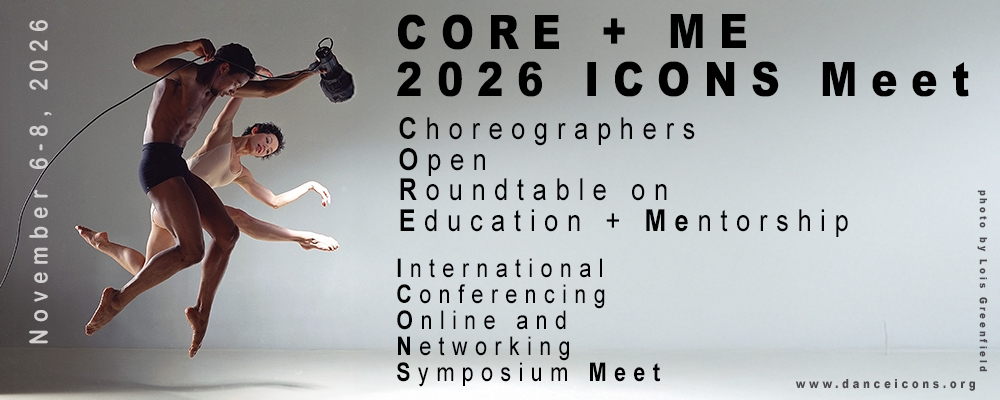
HERE IS A LIST OF A FEW CONFIRMED PRESENTERS AND CONTENT SESSIONS:
Welcoming Words, Vladimir Angelov, Dance ICONS, Inc. USA
Vladimir Angelov, Founding Artistic and Executive Director of the International Choreographers’ Organization and Networking Services – Dance ICONS, Inc. in Washington, DC, welcomes presenters and attendees to the first live online global conference focused on choreographers’ education, artistic training, and creative growth through mentorship. Following a brief introduction and overview of the conference mission and program, the first day of sharing sessions will begin.
Truth Telling, Risa Steinberg, The Julliard School , USA
A dialogue between internationally renowned mentor Risa Steinberg and Vladimir Angelov explores how feedback help choreographers more accurately translate their ideas into physical form. Just as choreographers pursue truthfulness in their work, mentors offer candid feedback by asking what the audience is meant to perceive and comparing that intention with what they observe. Mentorship strategies and utilizing phrasing like "Have you thought about..." help maintain neutrality and avoid imposing personal aesthetics.
Wise_Bodies, Mario Piazza, Accademia Nazionale di Danza, ITALY
Wise_Bodies explores how receptive visions can be embodied through choreography. The creative process is approached as an open daily diary, gathering images and ideas while testing forms of expression and interpretation. Through creative experimentation and reflection on the connections between people and their surroundings, initial ideas can organize themselves organically. The project’s receptivity also includes site-specific dance and inclusive actions that position dance beyond the concert stage.
Origins of Movement, Sifiso E. Kweyama, JazzArt Dance Theater, SOUTH AFRICA
Origins of Movement is a teaching methodology that generates original movement vocabulary from everyday practices rooted in African rural life, with reference to Zulu cultural traditions. Activities such as waking up, cattle milking, and hunting constitute embodied sources for movement generation. By privileging lived experience over abstract dance teaching conventions, this methodology facilitates culturally situated, intuitive creative practice, enabling dance artists to articulate embodied knowledge, affirm cultural identity, and develop authentic movement languages grounded in indigenous experience.
Intuitive Threading, Susan Kempster, Central School of Ballet, UNITED KINGDOM
Intuitive Threading's goal is to move “beyond technique,” release control, and find more instinctive, deeper body-mind connections. The aim is to unlock the choreographers’ intuition through “physical listening” during improvisation. By bypassing rational thought and focusing on bodily sensations, participants in a project can synchronize their nervous systems, build partnering sensitivity, and develop risk-taking and alert responsiveness. At high synchronization, creators can spontaneously structure a dance piece, discovering what emerges in the moment instead of relying on pre-planned mechanics.
Digital Drift – AI and Choreography, Nile H. Russell, American Dance Festival, USA
Digital Drift – AI and Choreography explores the implications of A.I. as both artistic collaborator and creator in the studio through discussion, critique, practice, and application. This ongoing inquiry examines whether engaging with A.I. tools as creative catalysts—and developing practical strategies for integrating them into the choreographic process—can expand the possibilities of movement research and creation.
Methods of Mentorship and Feedback, Peter DiMuro/Public Display of Motion, USA
Effective choreographic feedback and mentorship clarifies artistic intent and helps bridge the distance between an artist’s vision and, ultimately, a work’s performance. Rather than relying on critical judgment, productive feedback cultivates a problem-solving framework to help the work become more itself - more the choreographer’s intention. Through questions and dialogues, the role of the mentor, who acts as an artistic confidant to the choreographer, is to help translate internal concepts, images, and impulses into a fully realized, clear and tangible presentation.
R.E.A.L. Jillian Harris, Temple University, USA
R.E.A.L., which stands for Relational Embodied Active Learning, is a movement-generation method grounded in interpersonal neurobiology (IPNB), cognitive science, and learning theory. Through improvisation and collaborative choreography, participants disrupt habitual movement patterns, expand creative agency, and deepen embodied awareness. Adaptable across diverse populations and settings, R.E.A.L. acknowledges the parallels between learning and creating and draws upon the theory proposed by IPNB that “mind” extends beyond our own bodies, our own brains.
NextMoves, Anh Nguyen, Hong Kong Academy of Performing Arts, CHINA
NextMoves is the key project of Hong Kong-Macao Greater Bay, a professional development program for emerging choreographers recently held in June-August through a partnership among institutions in the professional dance field, the independent sector, and academia. The program involves Hong Kong Ballet, Guangzhou Opera House. The presentation will address the challenges of mentoring and providing artistic guidance to artists working across often-polarized artistic sectors.
Architecting the Body, Jonathan Royse Windham, Martha Graham Dance Company, USA
This approach draws noninvasive, often spontaneous thematic connections between contemporary character deconstruction and Martha Graham’s historic emphasis on dramatic tension and character building. Its creative strategies use character work, improvisation, and psychological states to reshape the “architecture of the body” and deconstruct phrase work, by generating both comedy and drama.
Blue Print, Raphael Miro-Holzer, BlueBox, AUSTRIA
BluePrint draws on its architectural meaning as a method for generating choreography through prompts that activate dancers’ physical responses. By using creative tasks such as ChoreoText, ChoreoImage, and ChoreoMapping, semantic expressions transform into kinetic forms, drawings become three-dimensional movement, and individual movement solos evolve into group dance compositions. By integrating language and images into movement and spatial formations, the method enables choreographers to reveal their unique interpretations and shared authorship.
Choreographic Architypes, Jacek Luminski, Academie Karol Szymanowski, POLAND
Choreographic Architypes proposes that ancestry, anthropology, and choreographic history are “living devices” embedded in the human body. While they cannot be taught in a conventional way, they can be awakened through multilayered approaches. Prehistoric and ancient rituals, along with their compositional structures, continuously inspire new content . “Rituals of passage,” such as life transitions, connect past practices with meaningful actions today, making every creation part of a continuing dancing history.
Framing Dance/ Screen Dance, Anabella Lenzu, National Dance Education Organization, USA
In the cinematic process of “framing a dance,” choreographic composition works hand in hand with photographic composition. Participants often struggle to translate movement from three-dimensional space to a two-dimensional screen while preserving a sense of visual depth and dimensionality. The session will also address the challenges of mentoring choreographers in understanding why and how to capture dance on film and video, as well as navigating exposure, budgets, and creative choices.
Choreographic Think-Tank, Moon-Ae Choi, ARTSinTANK, KOREA
Emerging choreographers collaborate as equals to integrate their individual ideas into one cohesive dance work within six days. The process includes a live musician, while the mentor helps balance artistic energies and strong individual voices without directing the work too rigidly. The goal is to support collective creation, and an organic environment for emerging choreographers.
MODULE, Sidra Bell, Sidra Bell Dance New York, USA
Movement Observed During Unique Laboratory Experiments – MODULE, functions as a biannual durational research laboratory rather than a traditional technique class. The practice prioritizes long-form improvisation and interdisciplinary collaboration, including ongoing partnerships with neuroscientists, somatic and performance practitioners, filmmakers, and poets. Sessions focus on "care" and the mathematical, embodied, and rhythmic patterns that emerge through long-form durational movement without product-based goals.
DEEP PLAY, Abby Zbikowski, Ohio State University, USA
Deep Play activates space and time in innovative ways through movement research and physical inquiry that challenge both body and mind while revealing new sources of meaning. Through structured play, participants build physical systems and insights without the pressure to produce a finished dance piece, freeing emerging choreographers from commercial constraints and enabling shifts in psychological space.
Un-Choreographing, Kaley Pruitt, State University of New York (SUNY) Brockport, USA
Un-choreographing is the practice of scaffolding dance performance experiences so that elements left undefined (the “unknowns”) shape and articulate the work’s resonance alongside its “choreographed” structures. This practice utilizes Re-Telling, Play-Framing, Tasking/Gaming, and other devices to allow the emergent ideas, interactions, and physical contributions of both audience members and performers to expand the possibilities of choreographic meaning-making in real time.
Plug-and-Play, Rick Tjia, CHOREOGRAPHY ONLINE, CANADA
This online learning format explores the challenges and benefits of distance learning by reducing artists fear and anxiety to support “fearless creativity.” Instruction also guides participating choreographers to use available resources—“use what you have”—rather than depend on ideal conditions. Teaching methods emphasize peer analysis, encouraging constructive and feedback focusing on the choreographer’s intent instead of subjective judgments about effectiveness.
Mentoring Social Activism and Engagement, Lynn Neuman, Artichoke Dance Company, New York, NY, USA
The Arts Incubator for Change Making mentors artists in integrating social activism and community engagement with creative processes and outcomes. The program supports projects that affect people, communities, and lived realities by helping artists ask relevant questions, develop choreographic approaches aligned with their needs and goals, and assemble effective teams to advance the work.
More information will be announced within the next few weeks as we receive confirmations from the selected presenters.
Please stay tuned and we appreciate your patience.